Belonging, Memory, and the Fragility of Peace
By Loretto Horrigan Leary

Guests at Lockwood-Mathews Mansion Museum in Norwalk during a private tour of Journey of Hope: The Irish American Immigrant Experience, held before the Gaelic American Club’s Fairfield screening of Rory Duffy’s documentary A Fragile Peace: Brexit and Northern Ireland. Pictured (L–R): Susy Gilgore, Executive Director, Lockwood-Mathews Mansion Museum; Kathy Olsen, Treasurer, LMM; Dr. Ashley Morin, Sacred Heart University, Norwalk Mayor Barbara Smyth; Gerard Angley, Consul General of Ireland, New York; Loretto Leary, IGHMF Education & Culture Director and Co-Chair of the Connecticut Ireland Trade Commission; Martin Dunleavy, Connecticut Ireland Trade Commissioner; Amy O’Shea, Vice President, Ireland’s Great Hunger Museum of Fairfield; and Connecticut State Representative Eilish Collins Main, Stamford, 146th District.

Loretto Leary, IGHMF Education & Culture Director and Co-Chair, Connecticut Ireland Trade Commission with Consul General, Gerard Angley discussing the names, ages at death and the Famine related diseases of Irish Famine immigrants engraved on artist Rowan Gillespie's sculptures, Statistic I & II in the servants' bedroom at Lockwood Mathews Mansion Museum in Norwalk, Connecticut.

The screening of Rory Duffy’s documentary A Fragile Peace: Brexit and Northern Ireland at the Gaelic American Club in Fairfield examined the impact of Brexit on the Good Friday Agreement, the Irish border, and the delicate balance of identity in a society still shaped by the legacy of conflict
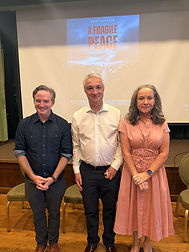
(L-R) Filmaker Rory Duffy, Consul General, Gerard Angley and Co-Chair, Connecticut Ireland Trade Commission, Loretto Leary
On July 12, as bonfires burned across parts of Northern Ireland for the Twelfth, also known as Orangemen’s Day, a Connecticut audience gathered to reflect on one of the most difficult questions facing divided societies: who belongs, who decides, and what happens when public symbols make some people feel at home while making others feel threatened?
That question gave added meaning to a Sunday program that began with a private tour of Journey of Hope: The Irish American Immigrant Experience at the Lockwood-Mathews Mansion Museum in Norwalk and continued with a screening of Rory Duffy’s documentary A Fragile Peace: Brexit and Northern Ireland at the Gaelic American Club in Fairfield.
The day connected Irish immigration history with contemporary questions of identity, memory, borders, and peace. At Lockwood-Mathews Mansion Museum, guests viewed an exhibition that explores the Irish immigrant experience in America and the long journey from displacement to belonging. The exhibition offered a meaningful setting to consider how Irish immigrants built new lives while carrying memories of hunger, loss, resilience, faith, family, and community.
Later that afternoon, the screening of A Fragile Peace invited attendees to consider another part of Ireland’s story: the continuing work of peace and reconciliation in Northern Ireland. The film examines the impact of Brexit on the Good Friday Agreement, the Irish border, and the delicate balance of identity in a society still shaped by the legacy of conflict.
The date of the screening mattered. July 12 remains one of the most symbolically charged days in Northern Ireland’s calendar. For some, the Twelfth is an expression of cultural identity, tradition, and community. For others, its public rituals can evoke fear, exclusion, or painful historical memory. A Fragile Peace opens with the image of a bonfire burning with the Irish Tricolour placed on top, reminding viewers that symbols are never neutral when they are experienced in divided communities.
During the panel discussion that followed the screening, the recent controversy surrounding bonfires displaying imagery of migrant boats and a replica mosque added urgency to the conversation. Panelists reflected on the line between cultural tradition, political protest, intimidation, free speech, and hate. These questions are not limited to Northern Ireland. They speak to wider challenges facing democracies today, including the United States.
The discussion returned again and again to the idea of belonging. Who is welcomed into a community? Who feels seen in public space? Who feels threatened by flags, murals, monuments, parades, bonfires, or other public symbols? And how can societies remember the past without allowing memory to become a weapon?
For Ireland’s Great Hunger Museum of Fairfield, these questions are deeply connected to our mission. The history of the Great Hunger is not only a story of famine, it is a multi- layered history of forced migration, exile, survival, public memory, and the struggle of a people to be recognized with dignity. Irish immigrants in America knew what it meant to be treated as outsiders. Their descendants also know the importance of preserving memory while building communities rooted in justice, compassion, and belonging.
The Good Friday Agreement, signed in 1998, remains one of the most important peace settlements of modern Irish history. Yet A Fragile Peace reminds us that peace is not a single achievement frozen in time. Peace must be taught, protected, renewed, and practiced across generations. Political agreements can create conditions for peace, but reconciliation requires trust, empathy, shared space, and a willingness to understand the fears and hopes of others.
Participants in the panel discussion included Gerald Angley, Consul General of Ireland in New York; Dr. Ashley Morin of Sacred Heart University; Rory Duffy, director and producer of A Fragile Peace: Brexit and Northern Ireland; Loretto Leary, IGHMF Education & Culture Director and Co-Chair of the Connecticut Ireland Trade Commission; her fellow Connecticut Ireland Trade Commissioner Martin Dunleavy; and Connecticut State Representative Eilish Collins Main of Stamford’s 146th District. Consul General Angley’s experience living in London during the Brexit negotiations and his memories of that time were of great interest to attendees who followed up with their own questions.
The afternoon at Lockwood-Mathews Mansion Museum and the later gathering at the Gaelic American Club showed how Irish history continues to speak to the present. From the story of Irish immigration to the ongoing work of peace in Northern Ireland, the day invited reflection on memory, identity, conflict, and the responsibilities we share in building communities where all people can belong.
Sincere thanks are extended to Lockwood-Mathews Mansion Museum for its hospitality and to Rory Duffy for bringing A Fragile Peace to Fairfield for such a timely and thoughtful community conversation.
For viewers who wish to rent Duffy’s documentary you can do so here: Maci Duffy Productions
The exhibition, A Journey of Hope: The Irish American Immigrant Experience is on display at Lockwood Mathews Mansion Museum until September 6 th 2026.